You probably don't know what regulated function feels like. Not because you haven't paid attention. Because you've adapted to a lower-functioning baseline for so long that the baseline became the reference point.
This is the silent version of the problem. There's no specific symptom to point at. Sleep is "fine." Energy is "okay." Mood is "manageable." Focus is "good enough." And the body is running at roughly 70% of its capacity, indefinitely.
You only notice the gap when you've experienced the other side of it.
What dysregulation looks like when it isn't loud
A regulated nervous system runs on a thermostat. It mobilizes when you need to mobilize. It downshifts when the demand stops. It doesn't lag, overshoot, or hold a state past its usefulness.
When the system is even mildly dysregulated, the thermostat stays slightly off. Not catastrophically. Persistently. Over months and years, you adapt to that baseline. The adaptation is the problem.
Subclinical dysregulation looks like:
- Sleep that's "okay" but never deeply restorative
- Energy that runs on coffee, then crashes around 3pm
- A working memory that's slower than it used to be
- A shorter fuse than you used to have
- Digestion that tracks emotional state more than food
- Recovery from workouts that takes a day longer than it should
- A general sense of having to push through the day rather than move through it
None of these are symptoms a doctor would treat. All of them are signals.
What regulated function actually feels like
Patients who get into a properly regulated state typically report the same shifts within four to twelve weeks:
- Sleep is deeper, and the morning doesn't feel like an emergency
- Energy is stable through the afternoon without sugar or caffeine
- Mood is steadier — same external stressors, different internal response
- Workouts feel like demand the body can absorb, not like an extraction
- Digestion runs on its own schedule rather than your stress level
- You stop noticing the body as a problem and start using it as a tool
The shift isn't dramatic. The dramatic part is realizing how much of your normal was actually adaptation to a lower setpoint.
What we measure
Subjective wellbeing is hard to track. The body offers cleaner signals if you know where to look.
- Heart rate variability (HRV). A direct read on parasympathetic capacity. We measure it at baseline and across care.
- Surface EMG (sEMG). Maps the chronic guarding patterns in your spinal musculature. A dysregulated system shows up here even when nothing specifically hurts.
- Thermography. Measures autonomic regulation of skin circulation along the spine. Asymmetries reveal where the system is compensating.
A patient at 70% looks different across these markers than a patient who's regulated. The shift over a course of care is measurable, not assumed.
Where the structural input fits
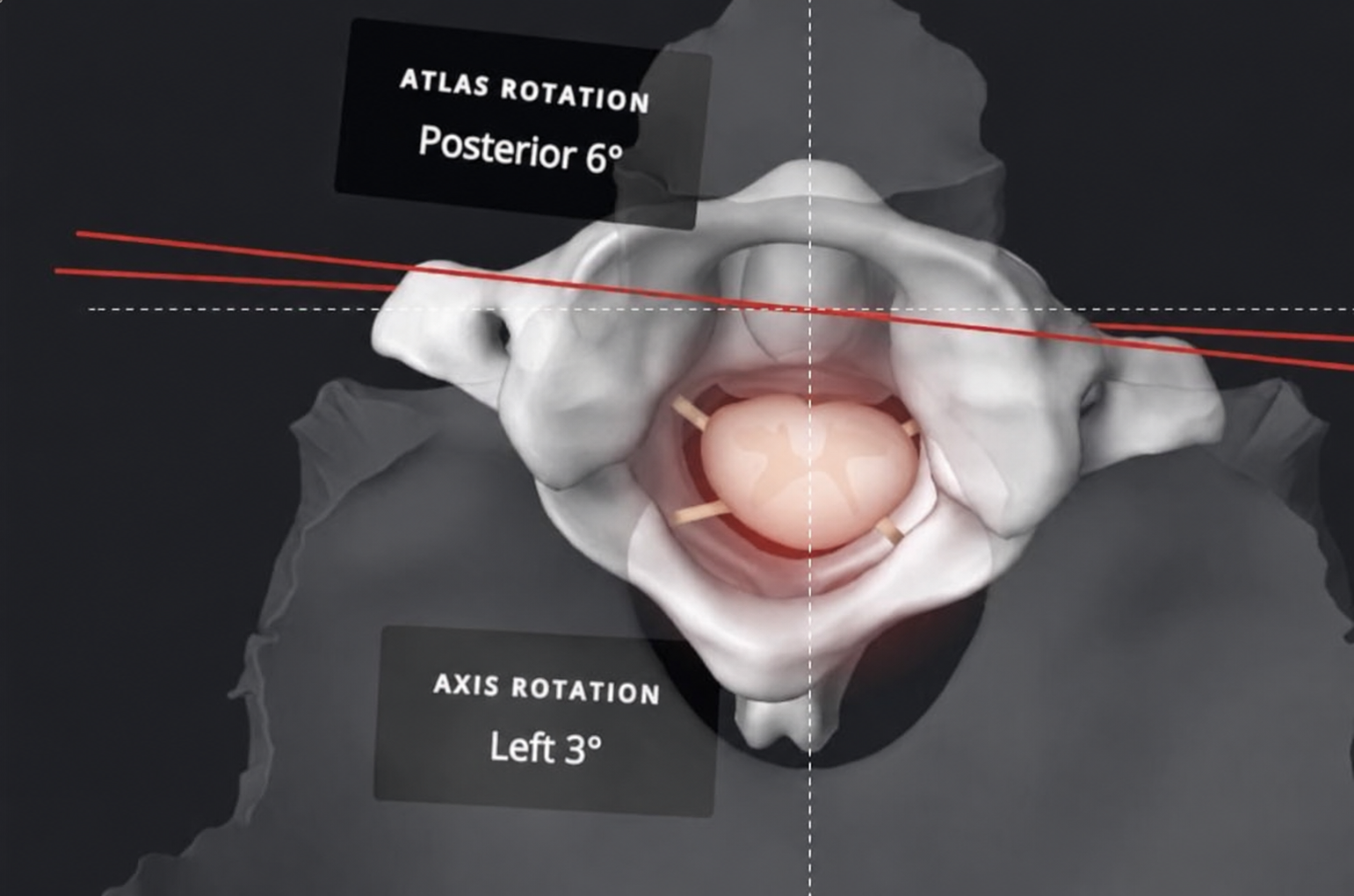
The nervous system reads its environment through structural signals, not thoughts. The atlas, the top vertebra in your spine, sits directly around the brainstem. When it's misaligned, the body keeps sending threat signals that don't match what's actually happening in your life. The system stays mildly mobilized for years. You feel that as the 70% baseline.
Atlas Orthogonal is an instrument-based, low-force correction calculated from upper cervical imaging. The corrective force vector is measured, not estimated. When the structural input clears, the brainstem reads its environment more accurately, and the body finds the higher setpoint it was capable of all along.
Where to start
If "feeling fine" is your current baseline and you suspect there's more in the tank, the right starting point isn't a new supplement protocol. It's a measurement of where the system actually is.
We baseline every new patient with imaging plus HRV, sEMG, and thermography. The first visit is the full assessment. The second visit is the report of findings and, when appropriate, the first structural correction. We don't correct on the day of the assessment — the precision depends on reviewing the data first.
If the data shows you're a candidate, the numbers move alongside how you feel. If something else is upstream, we'll tell you that too.
If you've been running on "fine" and want to know what your baseline actually looks like, schedule an assessment. We measure first, recommend second.