What Is Subluxation? A Clear Explanation
“Subluxation” is one of the most important words in chiropractic.
It is also one of the easiest words to misuse.
Some people hear it and think it means a bone is out of place. Others hear it and think it is outdated chiropractic jargon. Some clinics use it so vaguely that it stops meaning anything at all.
At Foresight, we use the word more precisely.
A subluxation is structural interference that changes how the spine moves, how the body compensates, and how the nervous system receives information.
The key word is interference.
The short answer
In chiropractic, subluxation can refer to altered spinal joint function that may affect movement, alignment, nerve communication, muscle tone, or physiological function. At Foresight, we define it practically as structural interference, especially when the spine is sending distorted input to the nervous system and the body is adapting around that signal.
Subluxation isn't just “a bone out of place”
The old explanation was simple: a bone moves out of place, pinches a nerve, and causes a problem.
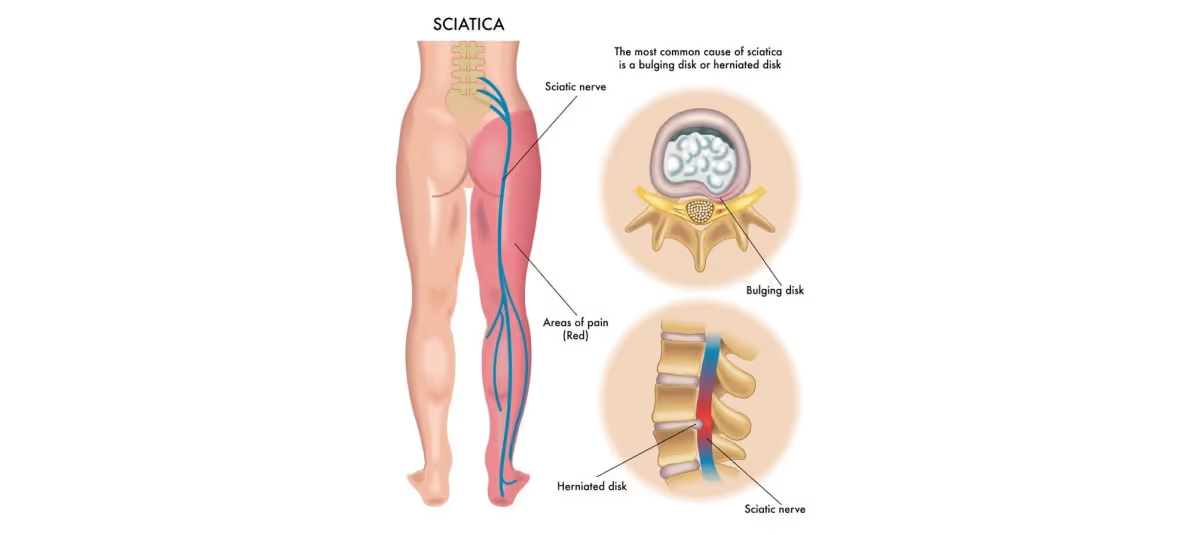
Sometimes nerve compression is real. Disc herniation, stenosis, radiculopathy, and trauma can absolutely affect nerves.
But that is not the full story of chiropractic subluxation.
Most subluxations are not dramatic dislocations. They are functional problems in motion, alignment, muscle tone, and neurological input.
A better explanation is this:
The spine is a communication structure. When a spinal segment is not moving or aligning properly, the nervous system receives altered information from that area. The body then adapts around that altered input.
That adaptation can show up as tension, compensation, pain, reduced range of motion, altered posture, fatigue, headaches, or a system that feels stuck in protection.
Why the medical and chiropractic definitions differ
In conventional medicine, subluxation usually means a partial dislocation that is visible structurally.
In chiropractic, the term has historically meant something broader: a dysfunction in a joint or motion segment that may affect biomechanical and neural integrity.
That distinction matters.
If someone expects the medical definition, they may assume chiropractic subluxation should always show up as a clear displacement on imaging.
But chiropractic subluxation is often a functional entity. It may involve movement, neurological signaling, muscle tone, compensation, and altered function rather than a dramatic bone displacement.
The problem is that the chiropractic profession has not always explained this clearly.
So we should.
The Foresight definition: structural interference
We prefer the term interference because it describes what matters clinically.
Interference means the body is not receiving or transmitting information as clearly as it should.
That interference can come from:
- altered joint motion
- upper cervical misalignment
- muscle guarding
- poor proprioceptive input
- postural compensation
- inflammation around stressed tissue
- trauma history
- repetitive mechanical strain
The body adapts to interference by protecting.
Protection is useful in the short term. But when protection becomes the baseline, function drops.
Why the atlas matters so much
Any spinal region can develop dysfunction, but the atlas is uniquely important.
The atlas is the top vertebra of the spine. It supports the skull and surrounds the transition between the brainstem and spinal cord.
Because of its location, the atlas influences head position, neck muscle tone, balance input, and sensory information traveling between the body and brain.
A small structural problem at the top of the spine can create a large compensation pattern below it.
That is why Foresight starts with the atlas.
Not because the rest of the spine does not matter.
Because the top of the system sets the tone for everything downstream.
How subluxation can affect symptoms
Subluxation should not be described as the cause of every disease. That is too broad and not clinically responsible.
But structural interference can affect how the body functions.
For example:
- altered upper cervical mechanics may contribute to headaches or neck tension
- poor spinal motion may increase muscle guarding
- compensation patterns may overload joints and soft tissue
- altered proprioceptive input may affect balance and coordination
- chronic guarding may feed pain sensitivity and fatigue
- nervous-system stress may affect recovery patterns
The stronger claim is not “subluxation causes disease.”
The stronger claim is “structural interference can change nervous-system input, and nervous-system input influences function.”
That is clear. It is defensible. And it is enough.
How we evaluate subluxation at Foresight
We look for measurable patterns.
A comprehensive neurological assessment may include:
- upper cervical structural analysis
- posture and range-of-motion evaluation
- Surface EMG to show muscle tension patterns
- Thermography to evaluate autonomic temperature asymmetries
- HRV scanning to assess autonomic adaptability
- clinical history of trauma, symptoms, compensation, and recovery
This helps us understand whether the body is adapting around interference.
What an adjustment is meant to do
An adjustment or structural correction is not about forcing the body into a position.
It is about restoring clearer input.
In Atlas Orthogonal care, the correction is low-force and instrument-based. The goal is to address the atlas with precision, not rotation or high force.
When interference is reduced, the nervous system has a better chance to organize around accurate information.
That is the principle.
Why this matters for patients
If you think symptoms are random, you chase them one at a time.
If you understand symptoms as outputs of a system adapting around interference, the strategy changes.
You stop asking only, “How do I make this symptom go away?”
You start asking, “What is my body adapting to?” That is the better clinical question.